Ceres
Intelligent Document Pipelines
A document AI platform that transforms raw documents into structured data at scale. Classifies, extracts, and digitizes across lending, logistics, KYC, and more.
The Problem
Every industry runs on documents. Loan applications, invoices, contracts, identity documents, shipping manifests. Yet the vast majority of these documents are still processed manually — teams of people opening PDFs, reading fields, and typing values into spreadsheets or systems.
This creates three compounding problems:
Speed. Manual processing creates bottlenecks that delay entire operations. A lending team processing 500 loan applications a day can't scale by hiring more people — they need infrastructure.
Accuracy. Human data entry has an error rate of 1-4%. At scale, that means thousands of incorrect records flowing into downstream systems — wrong loan amounts, misclassified documents, missed compliance flags.
Cost. The average cost to manually process a single document ranges from $6 to $25 depending on complexity. Multiply that by thousands of documents per day, and document processing becomes one of the largest operational expenses.
What Ceres Does
Ceres is a Document AI platform built for high-volume document ingestion and processing. It transforms unstructured documents — scanned PDFs, photos of forms, faxed contracts — into clean, structured data that systems can actually use.
The platform is built around five core capabilities:
Extract
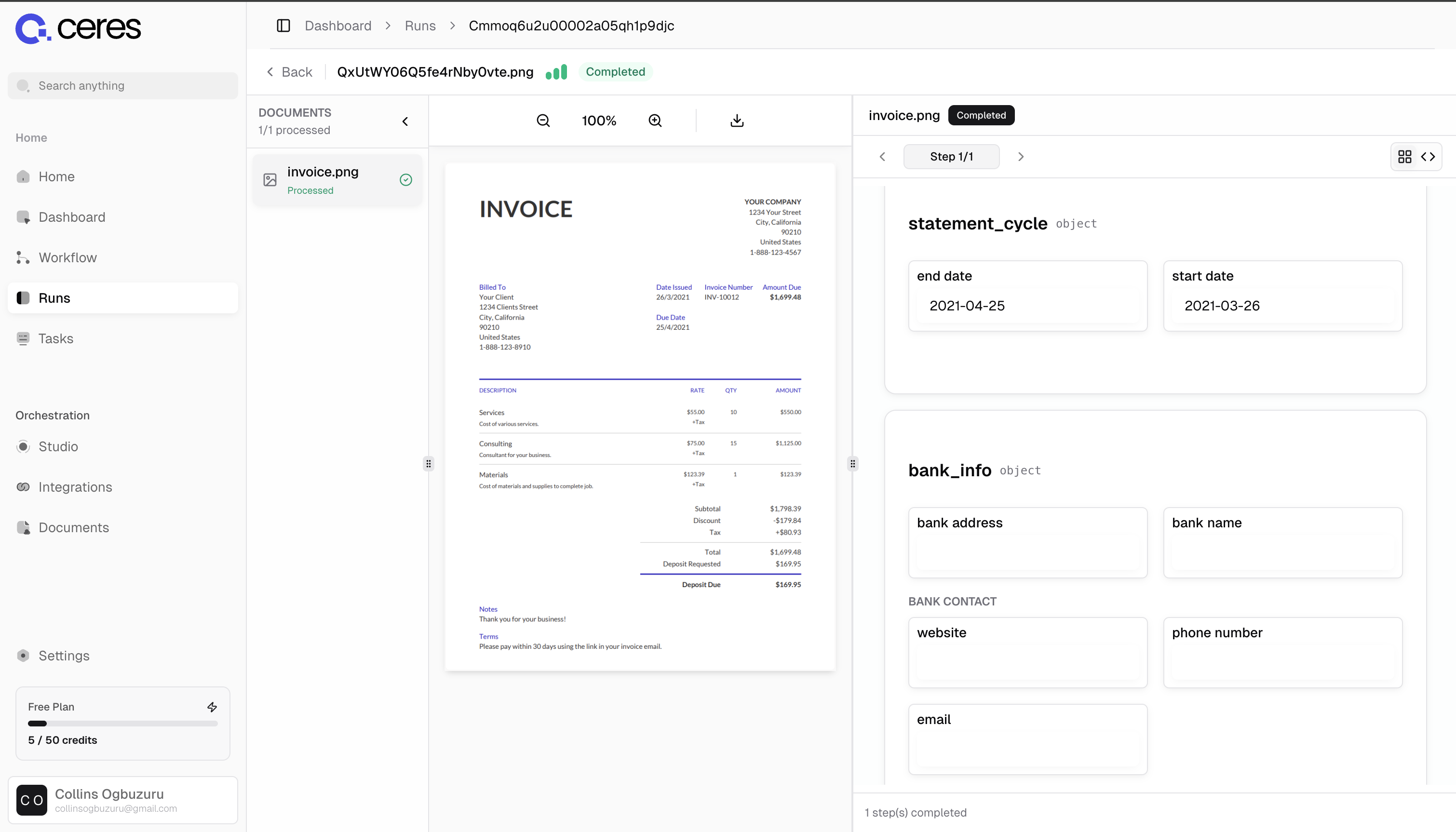
The extraction engine uses a universal prompt framework combined with OCR, handwriting recognition, and text alignment to pull structured data from any document type. Define what you need — names, amounts, dates, line items — and Ceres extracts it with high accuracy, even from handwritten forms and poor-quality scans.
Unlike traditional OCR tools that just convert images to text, Ceres understands document structure. It knows that a number next to "Total Due" on an invoice is the payment amount, not a reference number.
Classify
Documents are automatically categorized into user-defined types using a hybrid text and visual analysis engine. Upload a mixed batch of documents — tax returns, bank statements, pay stubs, ID cards — and Ceres sorts them instantly.
The classification engine handles diverse formats: PDFs, images, scanned documents, even photos taken at angles. It learns from corrections and improves over time.
Split
Many organizations receive bundled documents — a single PDF containing multiple invoices, or a loan packet with dozens of different document types stapled together. Ceres identifies logical boundaries within multi-page PDFs and separates them into individual documents automatically.
This is critical for lending operations where a single loan file might contain 30+ different documents that each need to be processed differently.
Digitize
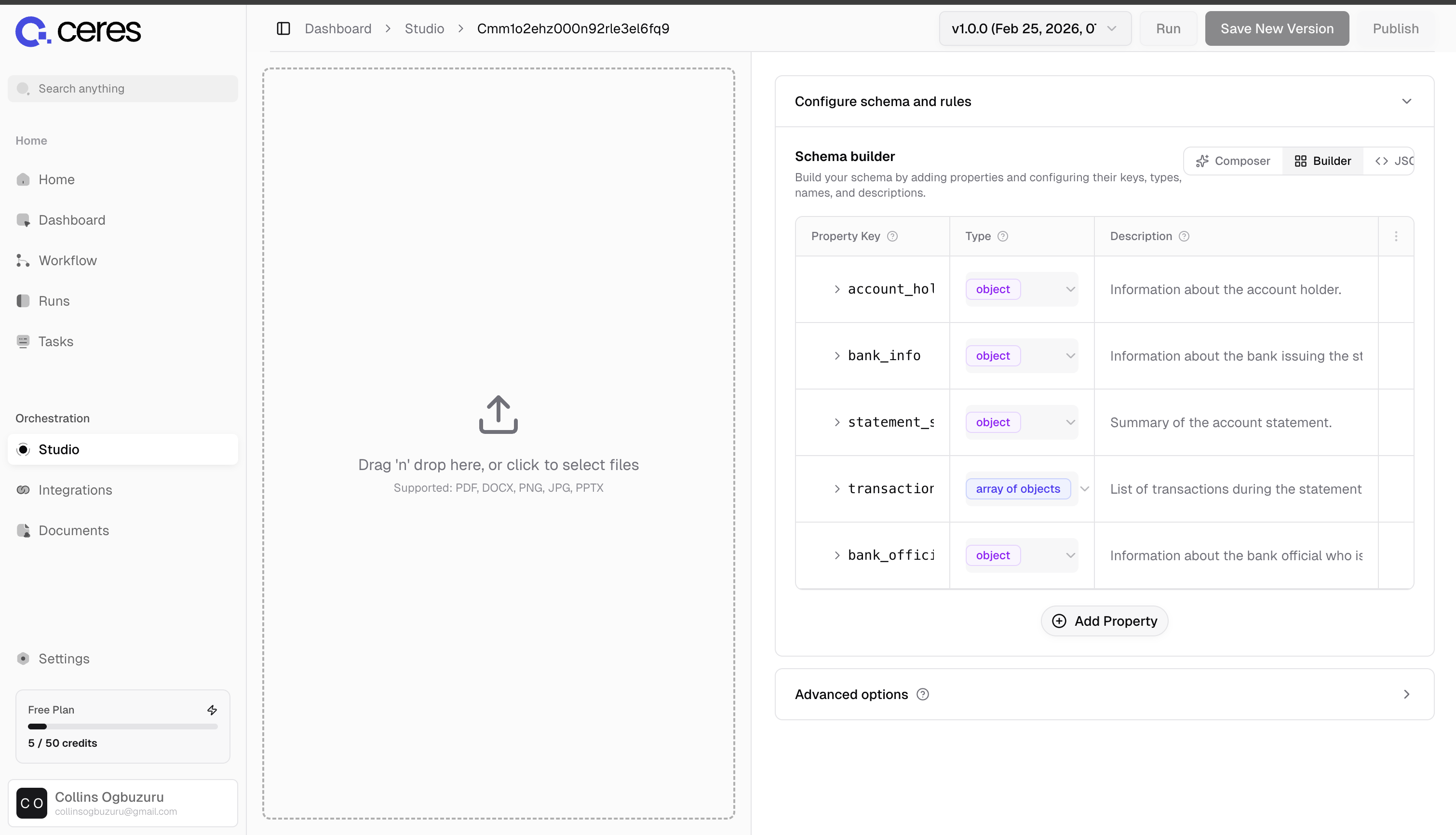
Ceres converts physical forms, scanned images, and legacy PDFs into structured, modern digital form schemas (JSON). Paper-based processes get transformed into digital workflows without manual re-keying.
A handwritten intake form becomes a structured JSON object. A faxed invoice becomes a database-ready record. Legacy paper archives become searchable, queryable data.
Ceres Go
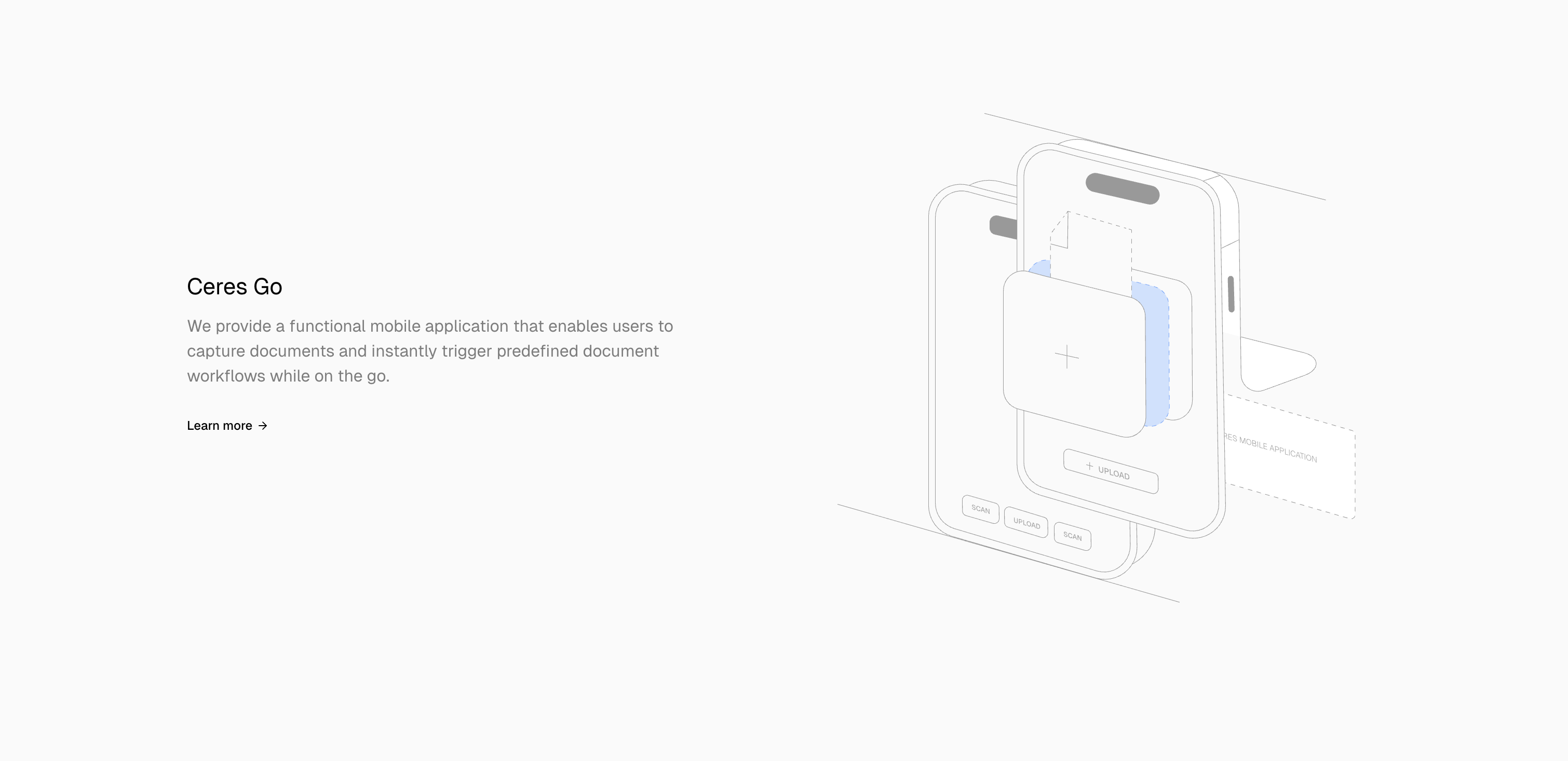
A mobile application that enables document capture and workflow triggering from anywhere. Field teams can photograph documents on-site and feed them directly into processing pipelines — no scanning, no emailing, no waiting.
Use Cases
Lending and Financial Services
Loan origination teams process thousands of documents per application — tax returns, bank statements, pay stubs, employment letters, identity documents. Ceres automates the entire intake pipeline:
- Split loan packets into individual documents
- Classify each document by type (W-2, 1099, bank statement, etc.)
- Extract income data, employer information, account balances
- Validate extracted data against application details
- Flag discrepancies for human review
Impact: Reduce loan processing time from days to hours. Eliminate manual data entry errors that cause compliance issues downstream.
Supply Chain and Logistics
Shipping operations generate massive volumes of Bills of Lading, customs declarations, packing lists, and delivery confirmations. Ceres handles:
- Mobile capture of shipping documents at warehouses and ports via Ceres Go
- Extraction of shipment details, tracking numbers, weights, and dimensions
- Signature verification on delivery confirmations
- Status tracking across document workflows
Impact: Eliminate the paper-to-digital gap that creates visibility blind spots in supply chains.
Finance and Accounting
Accounts payable teams process hundreds of invoices daily, each requiring line-item extraction, GL coding, and three-way matching. Ceres automates:
- Classification of incoming documents (invoice, credit memo, purchase order)
- Line-item extraction with quantities, unit prices, tax amounts
- Three-way matching between purchase orders, invoices, and goods receipts
- Exception flagging for price discrepancies or missing approvals
Impact: Cut invoice processing costs by 60-80%. Reduce payment cycle times from weeks to days.
KYC and Onboarding
Customer onboarding requires identity verification across dozens of document types — passports, driver's licenses, utility bills, bank statements. Ceres handles:
- Classification across 50+ identity document types from multiple countries
- Biometric data extraction from ID photos
- Address verification from utility bills and bank statements
- Fraud detection through document authenticity checks
Impact: Reduce KYC processing time from 48 hours to under 10 minutes per customer.
Legal and Real Estate
Contract management involves reviewing lengthy documents for specific clauses, dates, and obligations. Ceres enables:
- Digitization of paper contracts into searchable, structured records
- Extraction of renewal dates, termination clauses, payment terms
- Classification of contract types across portfolios
- Obligation tracking with automated date-based alerts
Impact: Transform static contract archives into active, queryable databases that surface risks and opportunities automatically.
How It Works
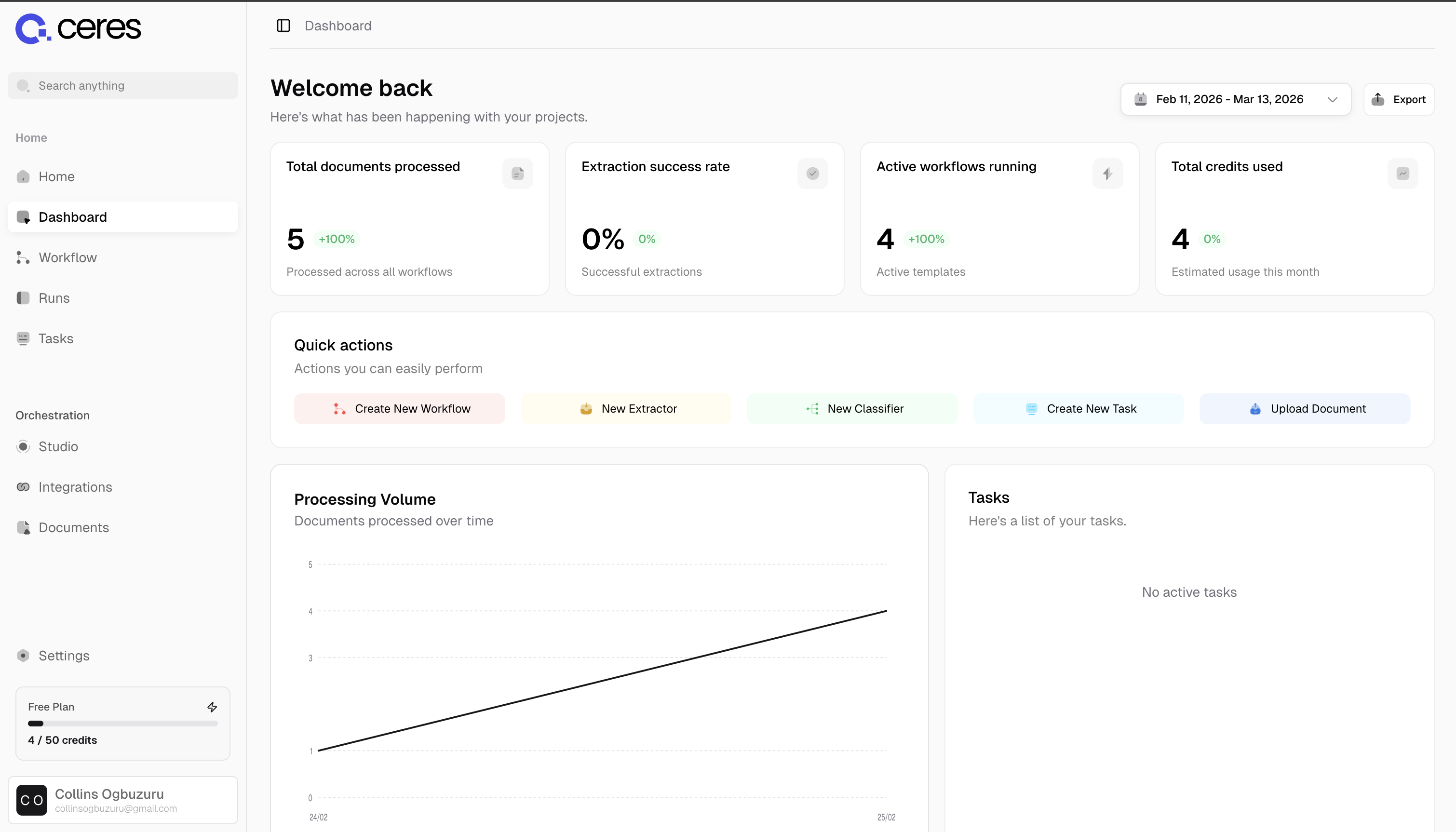
Ceres operates as an API-first platform with a web dashboard for configuration and monitoring.
1. Define your pipeline. Configure document types, extraction schemas, classification categories, and output formats through the dashboard.
2. Ingest documents. Feed documents via API, web upload, email forwarding, or Ceres Go mobile app. Ceres accepts PDFs, images (JPEG, PNG, TIFF), and scanned documents.
3. Process automatically. Documents flow through your configured pipeline — classified, split, extracted, and digitized without human intervention.
4. Review and export. Structured data is available via API or webhook. A review interface lets teams handle exceptions and edge cases that fall below confidence thresholds.
5. Improve continuously. Every human correction feeds back into the system. Accuracy improves with volume.
Why Ceres
Built for scale. Ceres isn't a document scanning tool — it's infrastructure for document-heavy operations. Process thousands of documents per hour, not per day.
Universal prompt framework. One extraction engine handles every document type. No need to build and maintain separate models for invoices vs. contracts vs. ID documents.
Production-grade accuracy. OCR, handwriting recognition, and visual analysis work together to handle real-world document quality — faded prints, coffee stains, angled photos, poor lighting.
API-first architecture. Every capability is available via API. Embed Ceres into existing workflows, ERPs, loan origination systems, or accounting platforms.
Mobile-ready. Ceres Go bridges the gap between field operations and back-office processing. Documents captured on-site enter the pipeline immediately.
Built by Skunkworks
Ceres was born from a real problem. Working with lending institutions across Nigeria, we saw teams of 20+ people spending entire days manually entering data from loan documents into systems. The error rates were high, the bottlenecks were expensive, and the solution was clear: build intelligent document infrastructure that actually works at scale.
Ceres is now processing documents across lending, logistics, and accounting operations — turning what used to take days into something that takes minutes.
Interested in Ceres?
Let's talk about how Ceres can work for your organization.